
The overwhelming majority of modern consumers discover products through social feeds, making fb ads an essential revenue driver for small and medium enterprises worldwide. Yet many business owners treat Meta’s advertising platform like a slot machine—pouring money in without a systematic approach. This comprehensive guide dismantles that gamble. Drawing from proven strategies used by thousands of profitable e-commerce brands, we’ll walk you through a repeatable framework to create facebook ads that convert browsers into buyers. Whether you’re managing a five-figure monthly budget or testing with your first $50, these tactics scale across industries, regions, and business models.
Why FB Advertising Delivers ROI When Other Channels Stall
Meta’s ecosystem reaches over three billion active users monthly, but raw reach explains only a fraction of its power. The platform’s algorithm continuously analyzes behavioral signals—recent purchases, content engagement, search patterns—to identify individuals with immediate purchase intent. This behavioral layer transforms advertising from educated guessing into targeted precision. Small business owners who master this signal-reading capability consistently outperform competitors spending triple their budgets on less sophisticated channels.
Independent data reveals that 41 percent of US retailers achieve their highest return on ad spend through fb advertising. While average conversion rates hover around 8.5 percent across all sectors, optimized small business accounts regularly report 4:1 to 5:1 revenue multiples. A dollar invested doesn’t simply generate two dollars—it creates a data asset that improves future targeting. Every click trains the algorithm, making subsequent campaigns more efficient.
The 2023 rollout of Meta Advantage+ fundamentally altered the calculus for resource-constrained teams. These AI-driven tools automatically redistribute budgets between ad sets, identify high-performing audience segments, and optimize creative delivery. Businesses using Advantage+ Shopping campaigns report cost-per-acquisition reductions averaging 17 percent and return-on-ad-spend improvements of 32 percent. For sole proprietors wearing multiple hats, this automation layer functions as a dedicated media buyer working around the clock.
The 7-Step Process to Make Facebook Ads That Actually Work
Step 1: Establish Your Business Foundation
Before launching any campaign, construct a Meta Business Portfolio through business.facebook.com. This centralized hub manages all assets—Pages, ad accounts, payment methods, and team permissions. Link an active Facebook Page, create a new ad account with appropriate time zone and currency settings, and assign role-based access for any collaborators. Configure a business credit card as your payment method to simplify expense tracking. This foundation prevents technical interruptions that kill momentum.

Step 2: Install the Meta Pixel Correctly
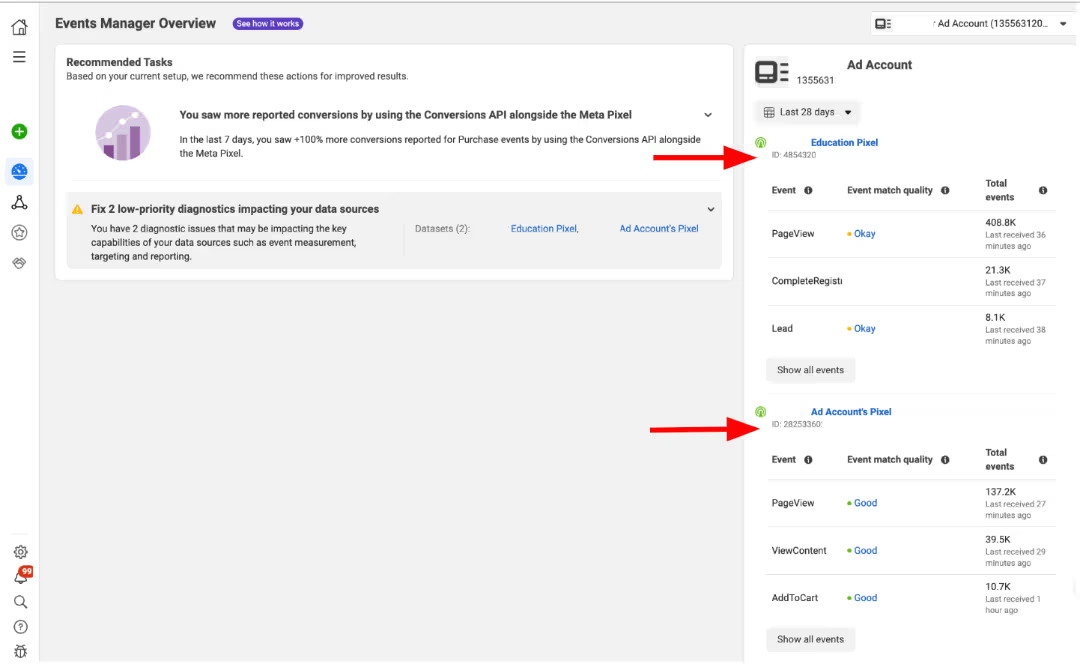
The Meta Pixel serves as your campaign’s nervous system. This code snippet tracks visitor actions—page views, add-to-carts, purchases—and feeds conversion data back to Facebook. Without it, you’re flying blind. Shopify users can install the pixel directly from the admin panel; other platforms require header code insertion. For maximum data capture, implement both the browser pixel and Conversions API. The API routes server-side data, circumventing iOS privacy limitations that block up to 30 percent of browser-based tracking.
Step 3: Select a Campaign Objective That Aligns With Revenue Goals
Facebook offers six core objectives: Awareness, Traffic, Engagement, Leads, App Promotion, and Sales. For product-based businesses, Sales delivers the highest quality traffic. The algorithm optimizes for purchases, not just clicks. Avoid the temptation to start with Awareness campaigns—they generate vanity metrics that don’t pay bills. Choose Sales, set your conversion event to “Purchase,” and let Facebook’s machine learning find buyers ready to transact.
Step 4: Configure Ad Sets With Precision
Each campaign contains ad sets that control targeting, budget, and scheduling. Start with three ad sets: one targeting broad interest-based audiences, one retargeting website visitors, and one exploring lookalike segments. Set daily budgets at five to ten times your target cost-per-acquisition. If you aim to acquire customers at $25, allocate $125-250 per ad set initially. Use manual placements initially—Facebook and Instagram feeds typically deliver the highest conversion rates for e-commerce. Disable Advantage+ placements until you understand baseline performance.
Step 5: Develop Creative Assets That Stop the Scroll
Your ad creative determines 70 percent of campaign success. Single-image ads still convert, but video and carousel formats consistently outperform static visuals. Create square (1:1) or vertical (4:5) videos under 15 seconds. Hook viewers in the first three seconds with movement, text overlays, or problem statements. For carousels, use the first card as a pattern interrupt, then showcase product variants or benefits across subsequent cards. Each card should link to a specific product page to simplify the purchase path.
Step 6: Publish and Navigate the Review Process
Clicking “Publish” triggers Facebook’s 24-hour review cycle. The system checks for policy compliance, image quality, and landing page consistency. Common rejection reasons include excessive text in images (keep overlay under 20 percent), unsubstantiated claims (“best,” “instant”), and slow-loading destination pages. Before publishing, run your landing page through Google’s PageSpeed Insights. Load times exceeding three seconds increase bounce rates by 40 percent, wasting ad spend before the first pixel fires.
Step 7: Exit the Learning Phase Before Optimizing
Facebook’s algorithm requires approximately 50 optimization events—purchases for Sales campaigns—within a seven-day window to exit the learning phase. Performance fluctuates significantly during this period. Resist the urge to tweak bids, budgets, or creative for at least three days post-launch. Premature adjustments reset the learning phase, extending volatility. Monitor delivery metrics daily but implement changes only after achieving statistical significance.
Budgeting Secrets: How to Run Facebook Ads Effectively on $50-$500 per Month
Start With Daily Budgets for Control
Lifetime budgets appeal to planners, but daily budgets provide tighter spend control for learning advertisers. A $50 daily budget across two ad sets gives each $25—enough for Facebook’s algorithm to gather meaningful data. Lifetime budgets work better for fixed promotions with clear end dates, but they can overspend early, exhausting your budget before identifying winning audiences.
Implement the 50 Percent Scaling Rule
When a campaign delivers profitable ROAS, increase budgets by 20-50 percent every 3-5 days. Never double spend overnight. The algorithm requires time to adjust to increased budgets; abrupt changes trigger a learning phase reset and efficiency collapse. This measured approach sustains performance while scaling revenue. Track frequency closely during scaling—if the same users see your ads more than three times, creative fatigue sets in, and costs rise.
Choose the Right Bidding Strategy for Your Stage
Beginners should use Lowest Cost automatic bidding. Facebook maximizes results within your budget without manual intervention. Once you identify a stable cost-per-acquisition, switch to Cost Cap bidding. Set the cap at 80 percent of your break-even CPA to maintain profitability while giving the algorithm breathing room. Avoid Bid Cap until you have months of performance data; manual bid restrictions often limit reach and stall growth for inexperienced advertisers.
Precision Targeting: Reaching Your Actual Buyers, Not Just Window Shoppers
Build Custom Audiences From Existing Assets
Upload customer email lists to create Custom Audiences. Facebook matches 60-70 percent of emails to profiles, enabling you to reactivate past purchasers or exclude existing customers from prospecting campaigns. Similarly, retarget website visitors from the last 30-180 days. Segment further: target add-to-cart abandoners with urgency messaging, and product page viewers with detailed benefit-driven copy. These warm audiences convert 3-5 times better than cold traffic.
Create Lookalike Audiences That Mirror Your Best Customers
Once you accumulate 100+ purchase events, generate a 1% Lookalike Audience based on customer value data. The algorithm identifies users sharing demographic and behavioral traits with your highest-LTV buyers. Test sequentially: 1% lookalikes deliver the closest match and highest conversion rates. Expand to 2-3% only after exhausting the 1% segment. For international scaling, create separate lookalikes by country—cultural nuances impact purchasing behavior significantly.
Layer Interests Strategically Instead of Stacking Them
Most advertisers mistakenly add multiple interests to one ad set (“fitness AND yoga AND running”). This creates confused targeting. Instead, create separate ad sets for each interest. This isolation reveals which passion points drive purchases, letting you allocate budget toward the highest-performing community. Test competitor brands, complementary products, and specific influencers within your niche. One e-commerce store discovered that targeting fans of a specific podcast outperformed broad “health” interest targeting by 220 percent.
Ad Formats That Convert: Choosing the Right Creative for Your Product
Carousel Ads for Discovery and Comparison
Carousel ads showcase up to ten products or features in a swipeable format. Use the first card to ask a question or state a problem: “Struggling to find the perfect gift?” Subsequent cards can display products suited to different personality types, price points, or use cases. This format reduces decision friction by curating options. Each card links independently, letting you track which products generate the most interest. A/B test carousel ordering—sometimes placing the highest-margin product on card three outperforms featuring it first.
Video Ads for Storytelling and Demonstration
Video remains the highest-converting format for products requiring demonstration. Create three video variants: an unboxing sequence, a problem-solution narrative, and a user testimonial compilation. Keep runtime under 30 seconds for broad audiences; retargeting ads can extend to 60 seconds for engaged viewers. Always design for sound-off viewing—85 percent of videos play muted. Use bold captions, clear visual demonstrations, and text overlays that communicate core benefits without audio.
Meta Advantage+ Catalog Ads for Retargeting
Formerly Dynamic Product Ads, this format automatically displays products users previously viewed. The pixel tracks browsing behavior and generates personalized carousel ads without manual creative development. This automation scales effortlessly—one ad set can retarget thousands of SKUs. Set up product sets to exclude low-margin items or out-of-stock inventory. Catalog ads typically achieve 30-50 percent lower CPAs than standard retargeting because they show exact products already considered.
Optimization Tactics That Double Your ROAS Without Increasing Spend
Prioritize Mobile-First Landing Pages
Over 75 percent of Facebook traffic originates from mobile devices. If your site loads slower than three seconds, you lose 53 percent of visitors before the page renders. Compress images, minimize JavaScript, and implement accelerated mobile pages (AMP). Simplify navigation to a single-column layout with thumb-friendly buttons. Enable guest checkout and integrate Apple Pay or Google Wallet—every additional form field reduces conversion probability by 11 percent.
Write Copy Using the Problem-Agitate-Solve Formula
Generic product descriptions fail to capture attention. Instead, identify a specific pain point your audience recognizes: “Tired of meal prep containers leaking in your bag?” Agitate the problem: “Spilled lunches ruin productivity and waste money.” Then present your product as the solution: “Our vacuum-seal containers guarantee zero leaks, backed by 10,000+ five-star reviews.” This framework creates emotional resonance and logical justification simultaneously. Keep headlines under six words and primary text to 125 characters—scarcity drives action.
Systematically A/B Test One Variable at a Time
Multivariate testing overwhelms small budgets. Isolate single elements: test image vs. video creatives with identical copy, or test two headlines with the same visual. Run tests for at least 72 hours to achieve statistical significance. Document results in a simple spreadsheet tracking CTR, CPC, and conversion rate. Over time, you’ll build a creative playbook specific to your audience. One SME discovered that ads featuring customer faces outperformed product-only shots by 40 percent—insight they applied across all future campaigns.
Scaling Your Winners: From First Sale to Predictable Revenue Engine
Identify Scale-Ready Campaigns Through Three Metrics
Scale only when campaigns meet these criteria consistently for 14 days: (1) ROAS exceeds your target by 20 percent, (2) CPA remains stable as daily spend increases, and (3) ad frequency stays below 3.0. Premature scaling destroys profitability. A campaign generating 5:1 ROAS at $50/day might collapse to 1.5:1 at $500/day if the audience isn’t deep enough. Use Facebook’s Audience Insights to estimate your target market size before scaling.
Implement Vertical and Horizontal Scaling Sequences
Vertical scaling increases budgets on proven ad sets. Increase spend by 30 percent every 72 hours, monitoring ROAS daily. If efficiency drops more than 15 percent, revert to the previous budget and pause scaling. Horizontal scaling duplicates winning ad sets into new audience segments—test different age ranges, geographic regions, or interest groups. This approach expands reach without exhausting original audiences. One retailer scaled from $100 to $10,000 daily spend by duplicating their winning ad set into 20 regional variations, each with tailored creative.
Deploy Automation Tools to Preservation Profitability
Manual campaign management becomes unsustainable beyond five ad sets. Platforms like Didoo’s AI Marketer perform 24/7 performance monitoring, automatically pausing underperforming ads and reallocating budgets to top performers. The system audits accounts daily, flagging issues like audience overlap, creative fatigue, and bid inefficiencies. For SMEs, this automation layer substitutes for hiring a dedicated media buyer—freeing founders to focus on product and customer experience while campaigns optimize in the background.
Avoiding the Five Budget-Draining Mistakes SMEs Make
Mistake 1: Choosing Awareness Objectives for Direct Sales
Awareness campaigns optimize for reach, not revenue. They generate impressive impression counts but zero purchase intent. Always select the Sales objective for e-commerce. If you need brand awareness, run a separate campaign with a micro-budget ($5-10/day) and exclude those users from your sales campaigns. This segmentation prevents the algorithm from confusing metrics and diluting your core conversion goal.
Mistake 2: Ignoring Mobile Experience Post-Click
Perfect ads can’t compensate for a broken mobile checkout. Test your entire purchase funnel on multiple devices before spending a dollar. Ensure forms auto-populate, buttons respond to thumb taps, and payment options include mobile wallets. One SME reduced cart abandonment by 28 percent simply by enlarging their checkout button and enabling Apple Pay—changes that took 20 minutes to implement.
Mistake 3: Setting and Forgetting Campaigns
The “set it and forget it” mentality burns budgets. Check performance metrics every morning, but restrict major changes to weekly reviews. Watch for frequency creep above 3.0—this signals audience exhaustion. When CPA rises 25 percent above your target, pause the ad set and launch new creative. Consistent monitoring prevents small issues from becoming expensive problems.
Mistake 4: Testing Too Many Variables Simultaneously
Changing headlines, images, audiences, and budgets in the same week produces confounding data. You won’t know what caused performance shifts. Follow the “one variable per test” rule. Document baseline metrics, implement a single change, and wait 72 hours before measuring impact. This discipline accelerates learning and prevents costly misattribution.
Mistake 5: Scaling Before Exiting the Learning Phase
Campaigns in the learning phase exhibit volatile performance. Increasing budgets during this window extends the learning period and amplifies inefficiency. Wait for Facebook to deliver 50 conversion events in a seven-day period before considering any scaling. Patience during this phase separates profitable advertisers from those who burn through cash chasing false promise.
Ready to turn your target audience into actual sales? Skip the spreadsheets and launch winning Meta ads in 1 min—paste your URL, pick a campaign, and let Didoo AI Agent do the rest. Start your free 7-day trial today and watch tomorrow’s revenue advertise itself.Frequently Asked Questions
Expect data, not profit, during the first seven days. The algorithm needs approximately 50 purchase events to optimize effectively. Most SMEs see initial sales within 72 hours, but consistent profitability emerges after 14-21 days of iterative testing. Track micro-conversions—add-to-carts, initiated checkouts—to gauge early interest while the system learns.
Meta recommends $20-30 per day per ad set as a functional floor. With a $50 daily budget, you can run two ad sets testing different audiences. This generates enough data for decisions within a week. Spending less than $15/day typically extends the learning phase indefinitely, making optimization impossible. Start small, but start sufficiently to gather actionable data.
Technically yes, but conversion tracking becomes challenging. You can direct traffic to Instagram Shopping, Facebook Marketplace, or Messenger checkout. However, without pixel tracking, you lose optimization data and retargeting capabilities. A simple one-page Shopify or WordPress site with pixel integration costs less than $30/month and unlocks the platform’s full potential. The ROI improvement justifies the minimal investment.
Test all formats against the same audience with identical budgets. Run single-image, carousel, and video ads concurrently for 5-7 days. The format generating the lowest cost-per-purchase wins. Generally, video excels for products requiring demonstration, carousels for catalogs with multiple SKUs, and single images for simple, visually striking products. Document performance by product category—what works for apparel may fail for electronics.
Beginners should start manual. Advantage+ automates targeting and creative decisions, but you need baseline performance data to evaluate its effectiveness. Run manual campaigns for 30 days to understand your core audiences, then test Advantage+ against your best-performing ad set. Many SMEs find that hybrid approaches—manual prospecting combined with Advantage+ retargeting—deliver optimal control and efficiency.