
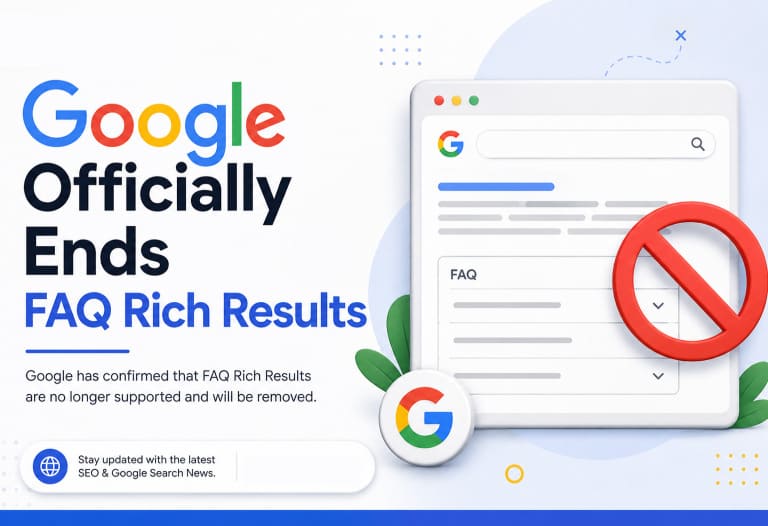
Google has officially killed FAQ rich results. As of May 7, 2026, FAQ structured data no longer produces the expandable answer snippets that filled search results pages for years. Google Search Console will stop reporting on FAQ data in June 2026, and the Search Console API follows in August 2026.
If your site has FAQPage schema—on help centers, product pages, service pages, or blog posts—you now face a practical decision: remove it, leave it, or replace it with something more valuable.
This guide gives you a direct, no-fluff answer to every question you actually have right now.
Key Takeaways
- FAQ rich results officially dead as of May 7, 2026 — your existing FAQPage schema won’t show in Google Search anymore
- Google says leave valid FAQ schema; it won’t hurt your site and other search engines may still read it
- The real action: audit your FAQ content quality, then remove thin content or replace with better schema types
- The bigger opportunity: optimize for AI citation, where well-structured FAQ content still carries weight
What’s Actually Changing: The Three-Date Timeline
Google’s FAQ rich results deprecation rolls out in three stages:
| Date | What’s Removed |
|---|---|
| May 7, 2026 | FAQ rich results stop appearing in Google Search |
| June 2026 | Search Console removes the FAQ search appearance filter, rich result report, and Rich Results Test support |
| August 2026 | Search Console API stops returning FAQ structured data |
The May 7 date is the one that matters right now. If you searched for your own pages with FAQ structured data the week before May 7 and again after May 7, you would have seen the expandable snippets disappear. Google’s official documentation on FAQ schema now reflects this change without fanfare — no separate blog post, just a quiet update to the documentation.
Why Google Did This: The Three-Year Buildup
The removal didn’t happen overnight. Google has been restricting FAQ rich results since 2023:
- April 2023: Google quietly reduced visibility of FAQ rich results for many sites
- August 2023: Google restricted FAQ rich results to “well-known, authoritative government and health websites”
- May 2026: The remaining exception for government and health sites is now gone too
The core reason, widely understood in the SEO community: FAQPage schema had become a manipulation tool more than a content format. Sites stuffed FAQs with keyword-targeted questions and answers to capture SERP real estate — not to genuinely help readers. Google’s solution: eliminate the feature entirely.
This is a pattern worth remembering. Schema-based SERP features are not permanent. Building a content strategy around structured data tricks is a fragile approach. Sustainable SEO still runs through genuine, useful content that serves reader intent.
Step 1: Should You Remove Your FAQ Schema?
The official answer from Google: Leave it. Unused schema doesn’t cause problems, and other search engines or AI systems may still read it.
The practical answer: It depends on your FAQ content quality.
Keep FAQ Schema If:
- Your FAQ content genuinely answers questions your users actually ask
- The FAQ is visible on the page as readable content — not hidden schema only
- The questions and answers reflect real expertise, not generic boilerplate
Remove or Overhaul FAQ Schema If:
- The FAQ was added purely for SEO and contains thin, generic answers
- The FAQ section is not visible or useful to human visitors
- The questions are keyword-stuffed variations that don’t reflect real user queries
Action item: Audit your pages with FAQPage schema using Google’s Rich Results Test or Schema.org’s testing tool. Check whether the content behind the schema is genuinely useful or just a SERP tactic. If your FAQ content existed only to capture rich results and would not be missed if deleted, that is a strong signal to remove it.
Step 2: Replace It With Better Schema Types
FAQ rich results are gone, but other structured data types still work — and some are more valuable for certain content. Here’s what you need to know about each active type:
| Schema Type | Best For | Rich Result Potential | AI Citation Value |
|---|---|---|---|
| Article | Blog posts, news, guides | ✅ News packs, article carousels | High |
| HowTo | Step-by-step tutorials | ✅ How-to rich results (limited) | High |
| Product | E-commerce product pages | ✅ Product rich results, reviews | High |
| FAQ | (still valid, just no rich result) | ❌ No Google rich result | Moderate |
| LocalBusiness | Local service businesses | ✅ Local packs, maps | High |
| Organization | Brand/company pages | ❌ No rich result | High for AI |
| Event | Event listings | ✅ Event rich results | Moderate |
| VideoObject | Video content pages | ✅ Video rich results | Moderate |
| Review/AggregateRating | Products, services, recipes | ✅ Star ratings in SERP | Moderate |
For most SMB blogs and content sites: Article schema on your posts, HowTo schema on tutorials, and Organization schema on your brand pages give you the best combination of SERP features and AI citation potential. Product schema is essential for any e-commerce operation.
Key principle: Only implement schema types that genuinely match your page’s primary content. Adding Product schema to a blog post about industry trends is not helpful — it misleads both search engines and readers.
Step 3: Optimize for AI Search Instead
The death of FAQ rich results is part of a larger shift: Google is moving toward AI-driven search experiences where traditional SERP features matter less. Your content now needs to perform in two systems simultaneously — traditional search and AI citation.
What Actually Works for AI Citation:
1. Direct, concise answers first AI systems extract the first clear answer they find. Put your main answer in paragraph 1 or 2 — not buried after a long introduction. Aim for 40-60 words per answer. For FAQ-style content, this means the answer to each question should appear in the first sentence, not after three paragraphs of context.
2. E-E-A-T signals matter more Experience, Expertise, Authoritativeness, Trustworthiness. AI systems evaluate source credibility explicitly. Show who wrote your content, what their credentials are, and why they should be trusted on this topic. Generic “author” bylines without context don’t count. This article is written by an SEO practitioner who has managed structured data implementations for sites ranging from local SMBs to national publishers.
3. Structured content with clear hierarchy Well-organized H2s, short paragraphs, and scannable content are easier for AI to parse and cite than walls of text. AI systems build their answers by pulling from structured, scannable sections — not from dense paragraphs. Every H2 in this article addresses one distinct question. Every answer starts fast.
4. Genuinely helpful content wins AI systems are trained to identify content that actually helps people. Thin FAQ pages that existed purely for schema will get ignored. Content that demonstrates genuine expertise and answers questions thoroughly will get cited. If your FAQ would survive deletion as a standalone web page — because people actually read it — it is worth keeping with or without schema.
Step 4: Adjust Your Measurement
With FAQ rich result reporting disappearing from Google Search Console, you need new ways to track content performance:
- Monitor overall Search Appearance clicks in Google Search Console — filter by page URL to isolate pages that previously had FAQ rich results
- Track AI search visibility through tools that monitor how your brand and topics appear in ChatGPT, Perplexity, and Google AI Overviews
- Set a calendar reminder for June 2026 to remove the FAQ report from your analytics dashboards — trying to track a metric that no longer exists creates noise, not signal
- Establish baseline rankings now for pages with FAQ schema — you want to know whether rankings changed after May 7, not argue about it six months from now
Your 30-Day Action Checklist
- [ ] Audit all pages with FAQPage schema using a structured data testing tool (Rich Results Test or Schema.org Validator)
- [ ] Decide per page: keep and improve thin FAQ content, or remove it entirely — don’t leave low-quality FAQ schema rotting on your pages
- [ ] Replace thin, SEO-only FAQ pages with quality Q&A content or migrate those pages to a different schema type (Article, HowTo, Product)
- [ ] Add Article or HowTo schema to your highest-traffic blog posts and guides
- [ ] Shift measurement from FAQ rich result impressions to overall search traffic and AI citation tracking
- [ ] Remove the FAQ report from your Google Search Console dashboard after June 2026
FAQs
No. Google explicitly states that unused or removed structured data does not cause ranking penalties. If your FAQ content is thin, removing the schema may actually improve how Google evaluates your page quality. The risk is not in removing schema — it is in having low-quality content that no longer gets a SERP boost from FAQ markup.
Only if the FAQ content behind the schema is low-quality or exists purely for SEO. Google’s official guidance is to leave it — it won’t hurt you. But if you’re using FAQ schema to stuff thin, unhelpful content, that’s the real problem, not the schema itself. Quality FAQ content is still worth keeping on your pages; just don’t expect a rich result from it.
It depends on your content type. E-commerce sites should prioritize Product schema with price, availability, and review data. Blog posts should use Article schema with author credentials and publication date. How-to content should use HowTo schema with step-by-step instructions. There is no single “replacement” for FAQ rich results — Google removed a feature, not a content type.
Possibly. ChatGPT and other AI systems can parse structured data as part of their content analysis. Keeping valid, helpful FAQ content with schema may still help AI systems understand your page — even without Google rich results. More importantly, the content itself, well-written and genuinely helpful, will be read and potentially cited by AI systems regardless of schema markup.
No. People Also Ask (PAA) is a separate SERP feature with different mechanics. FAQ rich results were the expandable blue-question panels generated by FAQPage schema. PAA results are algorithmically generated from page content. The FAQ rich results removal does not affect PAA listings.
Related Resources
- Google AI Max for Search in 2026: The Complete Migration Guide for Small Businesses — How Google is reshaping Search ads and the SERP itself in 2026.
- AI Advertising for Small Business: The Complete Guide — A broader playbook for SMBs adapting to AI-driven search and discovery.
- AI Advertising ROI: Cut $2 From Every $1 You Spend — Why raw traffic is no longer the right metric once AI answers take over the SERP.